INSPECTION PROCEDURE USING AN OSCILLOSCOPE


The output signals of the sensors and the conditions of the actuation signals of the actuators can be inspected visually by observing the waveforms on the oscilloscope.

INLET CAMSHAFT POSITION SENSOR AND CRANK ANGLE SENSOR


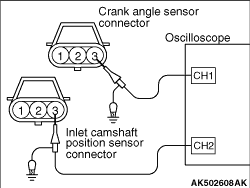
Measurement Method


1.Disconnect the intake camshaft position sensor connector and insert the special tool test harness (MB991709) in-between the separated connectors. (Always mate all the terminals.)
2.Disconnect the crank angle sensor connector and insert the special tool test harness (MB991709) in-between the separated connectors.
3.Connect the probe of each channel of the oscilloscope to terminal No. 3 of the intake camshaft position sensor connector and terminal No. 3 of the crank angle sensor connector, respectively.

Alternate Method (Measure at the engine-ECU)


1.Disconnect the engine-ECU connector and connect the special tool Power plant ECU check harness (MB992110) in between.
2.Connect the oscilloscope special patterns pickup to engine-ECU terminal CPI (When checking the intake camshaft position sensor signal wave pattern).
3.Connect the oscilloscope special patterns pickup to engine-ECU terminal SGT (When checking the crank angle sensor signal wave pattern).

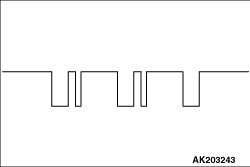
Standard Wave Pattern


Observation condition
Function
Special patterns
Pattern height
Low
Pattern selector
Display
Engine
Idle


Description of Wave Patterns


  • The inlet camshaft position sensor serves as to detect the compression top dead centre of each cylinder. By observing this signal simultaneously with the crank angle sensor signal, it is possible to identify each cylinder.
  • The crank angle sensor is used to detect the crank angle of each cylinder. While the engine revolves for two cycles, 72 pieces of the crank angle sensor signal (including any missing) will be sent.
  • The engine ECU carries out the engine control, using the fall signal (from 5 to 0 V) of the crank angle sensor. The rise signal (from 0 to 5 V) position does not affect the control.

Wave Pattern Observation Points


  • Verify that the sensor signal frequency increases as the engine speed rises.

Examples of Abnormal Wave Pattern


  • Example 1

    Wave pattern characteristics

      Rectangular wave will be transmitted while the engine is not started.

    Cause of problem

      Failed sensor interface


  • Example 2

    Wave pattern characteristics

      Wave pattern is displaced in the forward or backward direction.

    Cause of problem

      Loose timing belt
      Abnormal sensing section

INJECTOR


Measurement Method


1.Disconnect the injector connector and insert the special tool Test harness (MB991658) in-between the separated connectors. (Always mate all the terminals.)
2.Connect the oscilloscope probe to terminal No. 2 of the injector connector.

Alternate Method (Measure at the engine-ECU)


1.Disconnect the engine-ECU connector and connect the special tool Power plant ECU check harness (MB992110) in between.
2.Connect the oscilloscope special patterns pickup to engine-ECU terminal INJ1 (When checking the No. 1 cylinder).
3.Connect the oscilloscope special patterns pickup to engine-ECU terminal INJ2 (When checking the No. 2 cylinder).
4.Connect the oscilloscope special patterns pickup to engine-ECU terminal INJ3 (When checking the No. 3 cylinder).
5.Connect the oscilloscope special patterns pickup to engine-ECU terminal INJ4 (When checking the No. 4 cylinder).

Standard Wave Pattern


Observation conditions
Function
Special patterns
Pattern height
Variable
Variable knob
Adjust while viewing the wave pattern
Pattern selector
Display
Engine
Idle


Description of Wave Patterns
  • Normally the power supply voltage is shown. When the engine-ECU turns the injector drive signal ON, the voltage falls to approximately 0V during the period of the signal ON. (See Point B.)
  • When the engine-ECU stops the output of the injector drive signal, the voltage peak appears due to the counter electromotive force of the coil. (See Point A.) And then the power supply voltage returns to its normal value.
  • Injector operation time: fuel injection period determined by engine-ECU according to various sensor output values. Injector operation time = effective injection period + invalid injection period (invalid injection period: compensation of injector response delay due to decrease in power supply voltage)
  • Counter electromotive force of solenoid coil: the counter electromotive force is created in the injector coil when the engine-ECU stops the output of the injector drive signal.
  • Power supply voltage: the power supply voltage is shown when the engine-ECU stops the output of the injector drive signal ON. If this supply voltage is low, the injector operation time becomes longer as the invalid injection time becomes longer.

Wave Pattern Observation Points


  • Point A: The level of counter electromotive force of solenoid coil:
Solenoid coil counter electromotive force is low or doesn’t appear at all.
Short-circuit in the injector solenoid


  • Point B: Injector operation time
Operation time
Consistent with the displayed time on M.U.T.-III.
Force an excessive acceleration.
The drive period will once extend greatly, then will be settled to that corresponding to the engine speed.

IGNITION COIL (POWER TRANSISTOR CONTROL SIGNAL)


Measurement Method


1.Disconnect the ignition coil connector and insert the special tool test harness (MB991658) in-between the separated connectors. (Always mate all the terminals.)
2.Connect the oscilloscope probe to terminal No. 1 of the ignition coil connector.
3.To verify the ignition advance angle, observe it simultaneously with the crank angle sensor output signals.

Alternate Method (Measure at the engine-ECU)


1.Disconnect the engine-ECU connector and connect the special tool Power plant ECU check harness (MB992110) in between.
2.Connect the oscilloscope probe to engine-ECU terminal CIL1. (When checking the No. 1 cylinder.)
3.Connect the oscilloscope probe to engine-ECU terminal CIL2. (When checking the No. 2 cylinder.)
4.Connect the oscilloscope probe to engine-ECU terminal CIL3. (When checking the No. 3 cylinder.)
5.Connect the oscilloscope probe to engine-ECU terminal CIL4. (When checking the No. 4 cylinder.)

Standard Wave Pattern


Observation condition
Function
Special patterns
Pattern height
Low
Pattern selector
Display
Engine
Idle


Description of Wave Patterns


  • Power transistor ON condition:
    An interval when the power transistor is ON and the primary side of ignition coil is conducted (referred to as "dwell interval") This conduction period gets longer if the battery voltage is low or vice versa so that the primary voltage at ignition can be controlled to a constant level.
  • Power transistor OFF condition:
    This interval corresponds to when the power transistor is OFF and the power transistor drive signal is not sent from the engine-ECU.

Wave Pattern Observation Points


  • Verify that the power transistor control signal (ignition timing) advances as the engine speed increases.

Examples of Abnormal Wave Pattern


    Wave pattern characteristics

      The voltage is low.

    Cause of problem

      Open-circuit in the ignition primary circuit.